
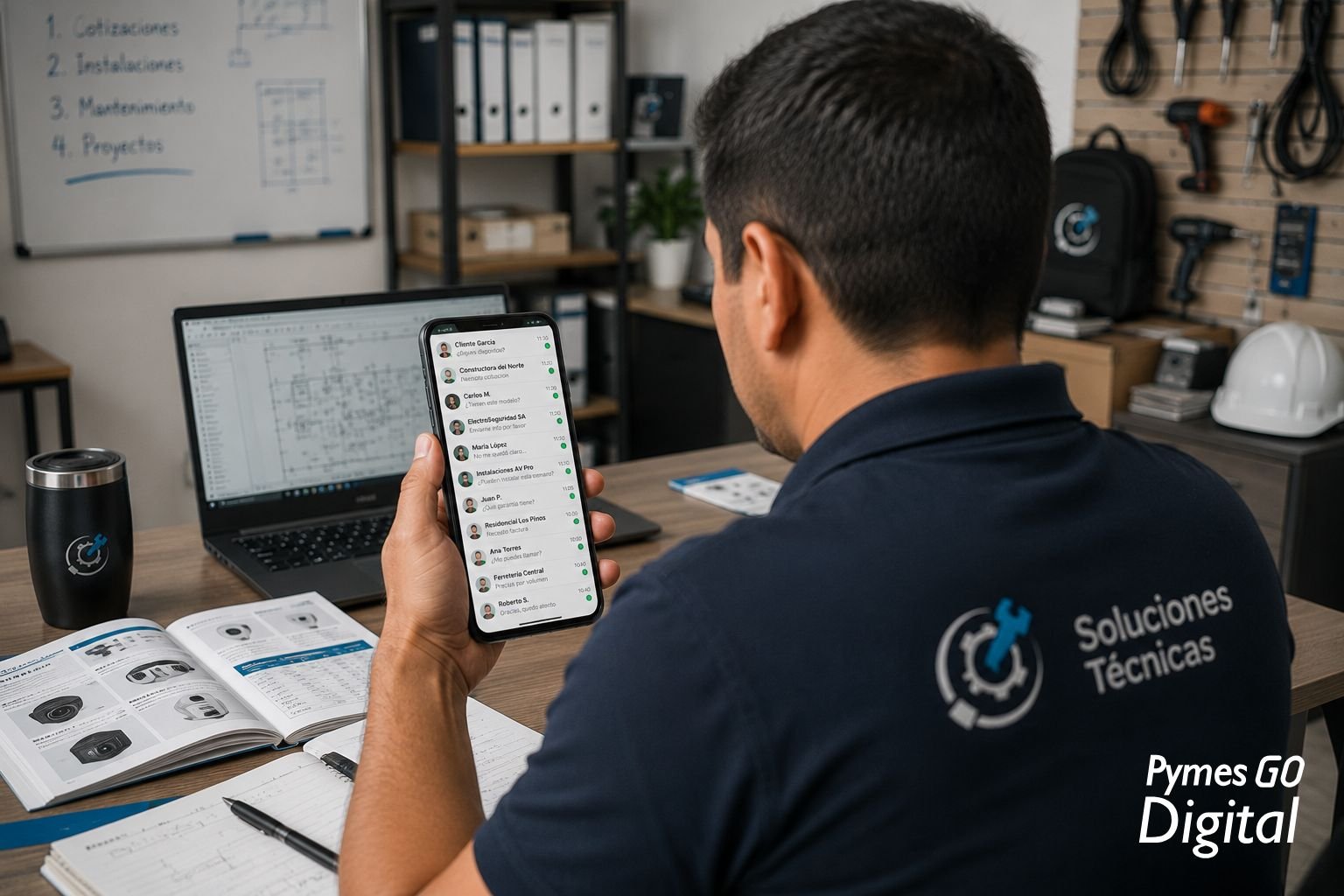
A security integrator with 5 field technicians receives between 15 and 20 WhatsApp messages daily. Quotes, schedules, warranties, maintenance requests. Most have standard responses. All go through the same 2 or 3 people.
When those individuals are on-site or in a meeting, messages accumulate. Some clients wait. Others don't.
The situation in an HVAC company is not very different: the same questions about preventive maintenance every season, answered manually every time. In a Pro AV integrator, the technical team ends up answering commercial inquiries because no one else is available. The channel changes. The problem remains the same.
A chatbot solves a specific part of that problem. Only that part.
What is a chatbot and what is its purpose in a technical company?
A chatbot responds to messages automatically, following predefined rules or using a language model that interprets questions and generates answers. It does not learn or adapt on its own. It is, in concrete terms, a way to automate the responses your team already provides daily to the same questions.
In a well-configured technical SME, it can handle after-hours inquiries, reduce the volume of messages reaching the operational team, and confirm that no request goes unanswered.
What it cannot do: replace the judgment of someone who knows the business, handle situations requiring negotiation or empathy, or solve problems outside its knowledge base. This distinction matters before configuring anything.
Why customer service becomes a bottleneck
The same questions, every day
In most technical companies, between 60% and 70% of incoming inquiries are repetitive: schedules, approximate prices, coverage areas, response times. Legitimate customer questions that do not require a senior technician to answer them one by one. In many companies, that is exactly what happens.
Human availability is not a system
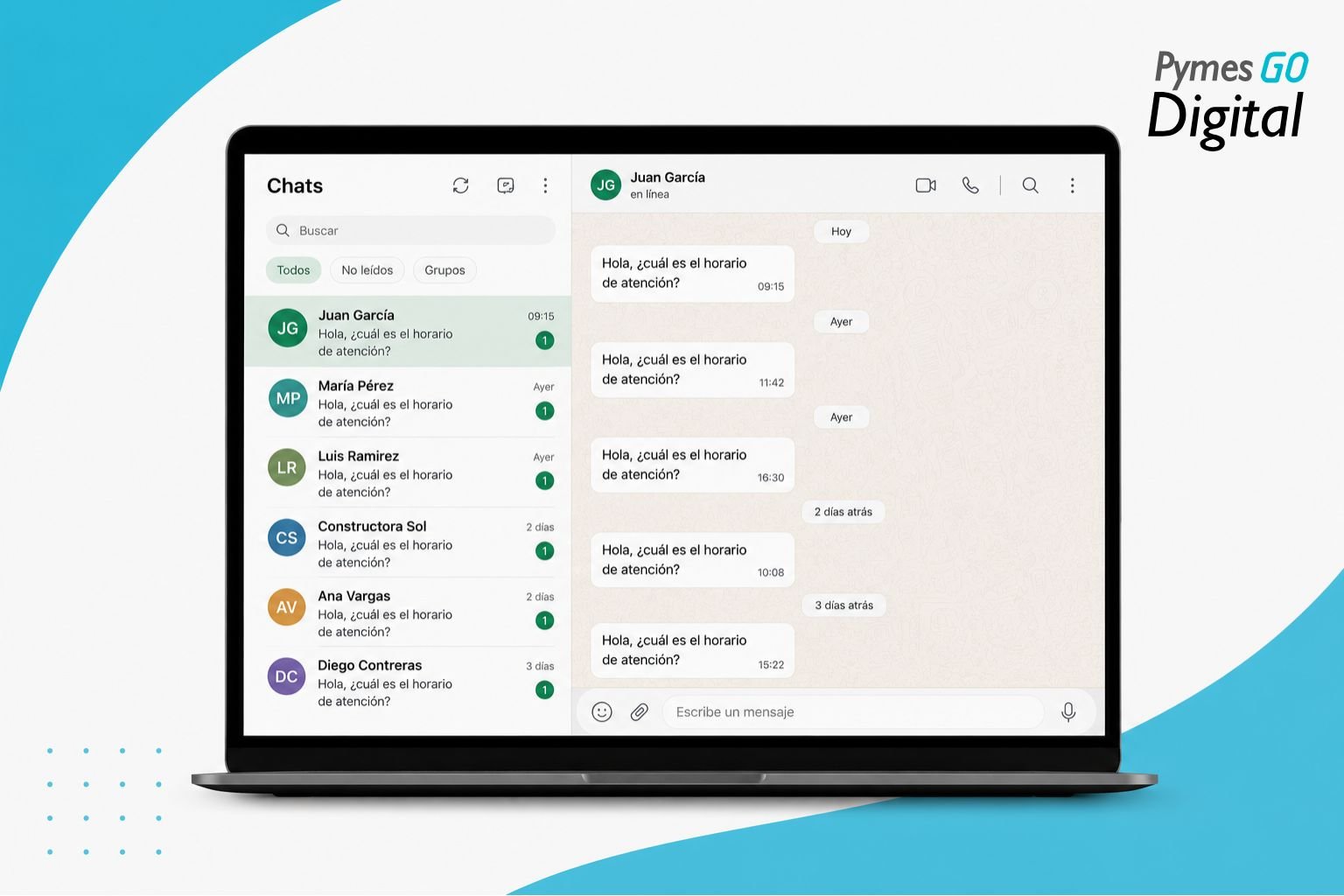
When responsiveness depends on 1 or 2 people, service consistency fluctuates according to their schedules. A client who writes on Friday at 6 PM has a radically different experience than one who writes on Tuesday at 10 AM. It's not an attitude problem; it's a structural problem.
Channels multiply, the team does not
WhatsApp, email, Instagram, website form. A specialized subcontractor with 8 employees cannot monitor all these channels with consistent quality. Some inquiries get lost. Others arrive late. The customer experience reflects the company's internal fragmentation.
An unanswered inquiry in the first few hours rarely turns into business
In technical B2B, where buying cycles are longer and trust is crucial, a delayed response communicates something about how the company operates. Not always fairly, but it communicates.
What a chatbot can solve in your company
The usefulness of a chatbot directly depends on how well the company's existing knowledge is documented. If the answers exist but reside in the heads of 2 people, the chatbot cannot reproduce them. If they are documented and clear, it can deliver them consistently 24/7.
The most concrete applications for technical companies:
- Automatic responses to frequently asked questions. Schedules, coverage areas, service types, estimated response times. Answers your team already provides manually and that can be automated without losing quality.
- Immediate acknowledgment of receipt after hours. Confirm receipt of the message, inform when a response will be provided, and, if applicable, capture necessary information via a form. It seems simple. It reduces the client's feeling of abandonment more than it appears.
- Pre-qualification of requests. Collect basic information before a human intervenes: equipment type, location, urgency, nature of the problem. The person who responds arrives with context and doesn't have to start from scratch.
- Orderly routing. Instead of the client explaining their problem 3 times on different channels, the chatbot identifies the type of request and redirects it to the correct place.
- Post-service follow-up. Confirm a technical visit, request basic feedback, or remind of an upcoming maintenance date. Low-effort interactions that create an impression of order.
When not to use a chatbot
There are situations where a chatbot creates more problems than it solves.
Complaints and conflicts. A client with a real problem who receives automated responses perceives it as indifference. The reputational cost of that interaction outweighs any operational savings.
Without documented and approved answers. A chatbot that improvises on prices, deadlines, or warranties produces errors that someone will have to correct manually, with more friction than if a human had responded from the beginning.
On a disorganized process. If the company has not defined who responds, how, and when, the chatbot will replicate that disorder at a faster pace. Automation amplifies what already exists, for better or worse.
What your company needs before configuring any tool
Documented and approved FAQs. It's not enough to know that customers ask the same questions; you need to have those questions written down with their exact answers, reviewed and approved by someone with the authority to do so. Without that, there is no knowledge base to train.
A human transfer protocol. Define what type of inquiry should exit the chatbot and reach a person, within what timeframe, and through which channel. Without this, the chatbot becomes a dead end for the customer.
A channel to start with. A company that implements a chatbot on WhatsApp, email, and social media simultaneously almost always ends up not configuring it well on any. Start where the largest volume of inquiries comes in. The rest comes later.
How to get started: 6 steps
Step 1. Document the 10 questions your team answers multiple times a week, without significant variations. Write the exact answer as it should reach the client.
Step 2. Identify the channel with the highest volume of inquiries. For most technical companies in Latin America, it's WhatsApp.
Step 3. Choose a tool appropriate for the size of your operation. Custom development is not necessary: Tidio, ManyChat, and Respond.io allow you to configure a basic chatbot on WhatsApp without code. The choice depends on the volume of messages and the available budget, not on how many features the platform has.
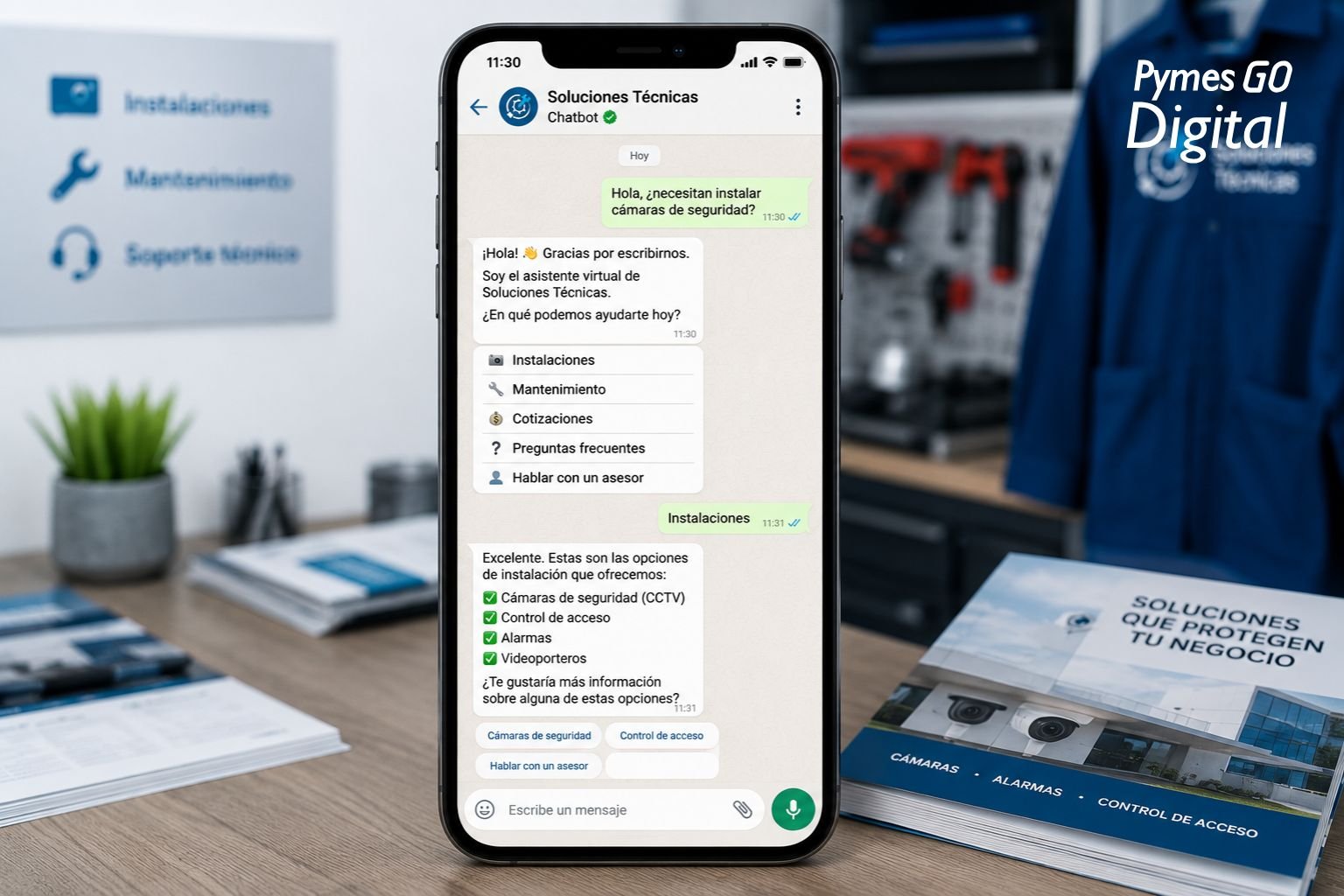
Step 4. Configure the basic flow: automatic greeting, menu with documented questions, corresponding answers, and a clear option to speak with a person. Only that for now.
Step 5. Run the chatbot in parallel with manual support for 2 weeks. Review which questions are not covered, which answers cause confusion, and how many conversations end without the client getting what they were looking for. This information is worth more than any initial configuration.
Step 6. Once the basic flow works consistently, add new questions, flows, or channels. Not before.

What you get in the end
A technical company that implements this well gains consistency at the first point of contact. No message goes unacknowledged. Fewer repetitive inquiries reach the operational team.
That, in a company where service currently depends on who is available, is already a concrete step forward.
The customer relationship, the one that builds trust and closes deals, still requires human presence. The chatbot handles the repetitive tasks so that presence can occur where it truly matters.
Want to see more AI applications in customer service?
This article is part of the AI for Customer Service in SMEs Hub, where you will find use cases, practical applications, and resources to structure your company's customer service with artificial intelligence.