
At the end of the quarter, the owner of a Pro AV integration company with 18 employees has to answer a basic question: how did we do?
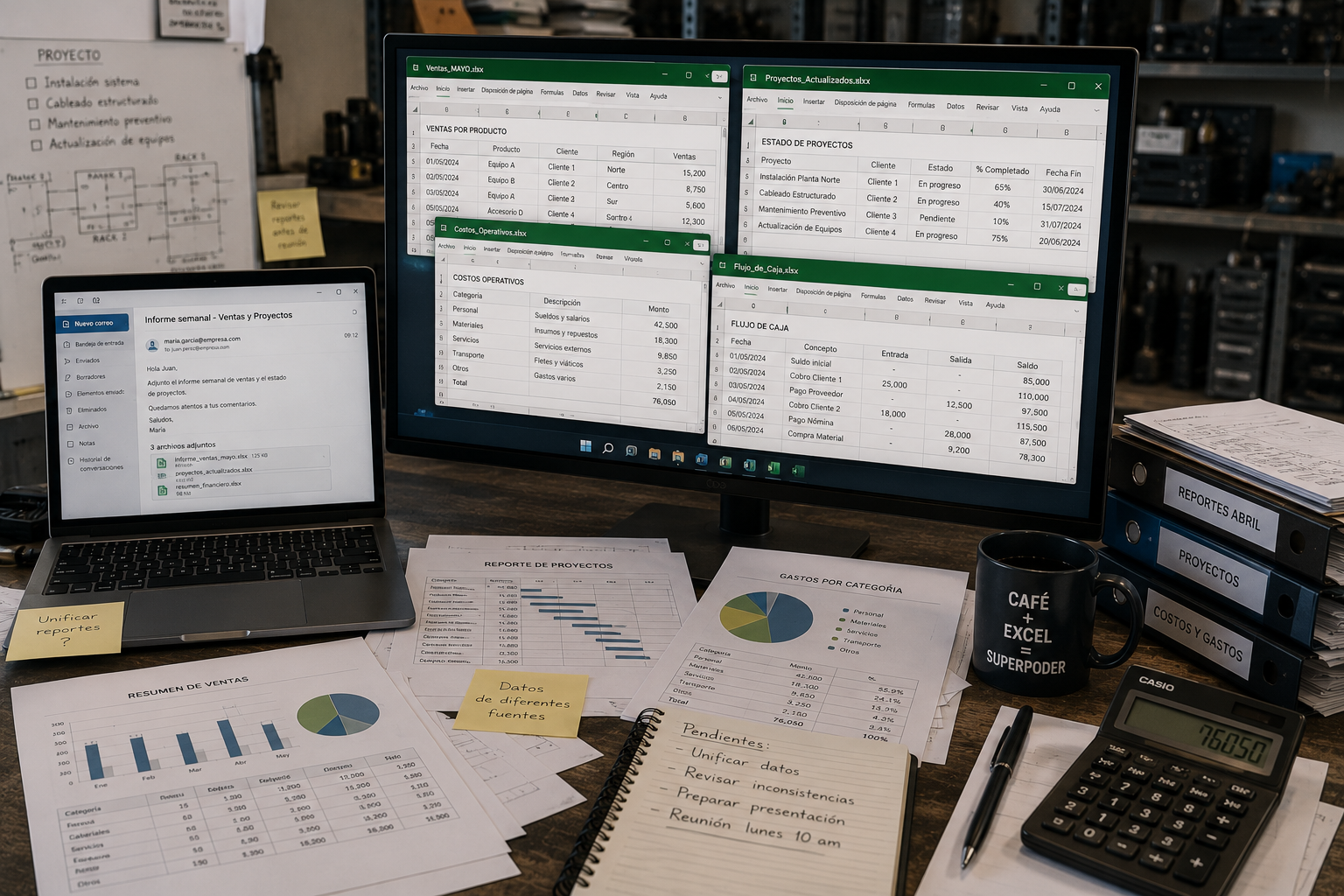
To find out, they have to cross-reference the sales report with project tracking, compare installation costs against original quotes, review which clients renewed service and which disappeared. That's 4 different sources. Each has its own format. No one cross-references them automatically.
The result is usually one of two things: either the analysis never happens, or the owner does it on a Sunday afternoon with 3 Excel spreadsheets open.
The information exists. The problem is that no one has time to process it.
That's exactly what AI can solve.

What Does Using AI to Analyze Your Business Mean?
Using AI to analyze your business means being able to ask questions about your own data and get answers in minutes, without needing a data analyst or building a complex dashboard.
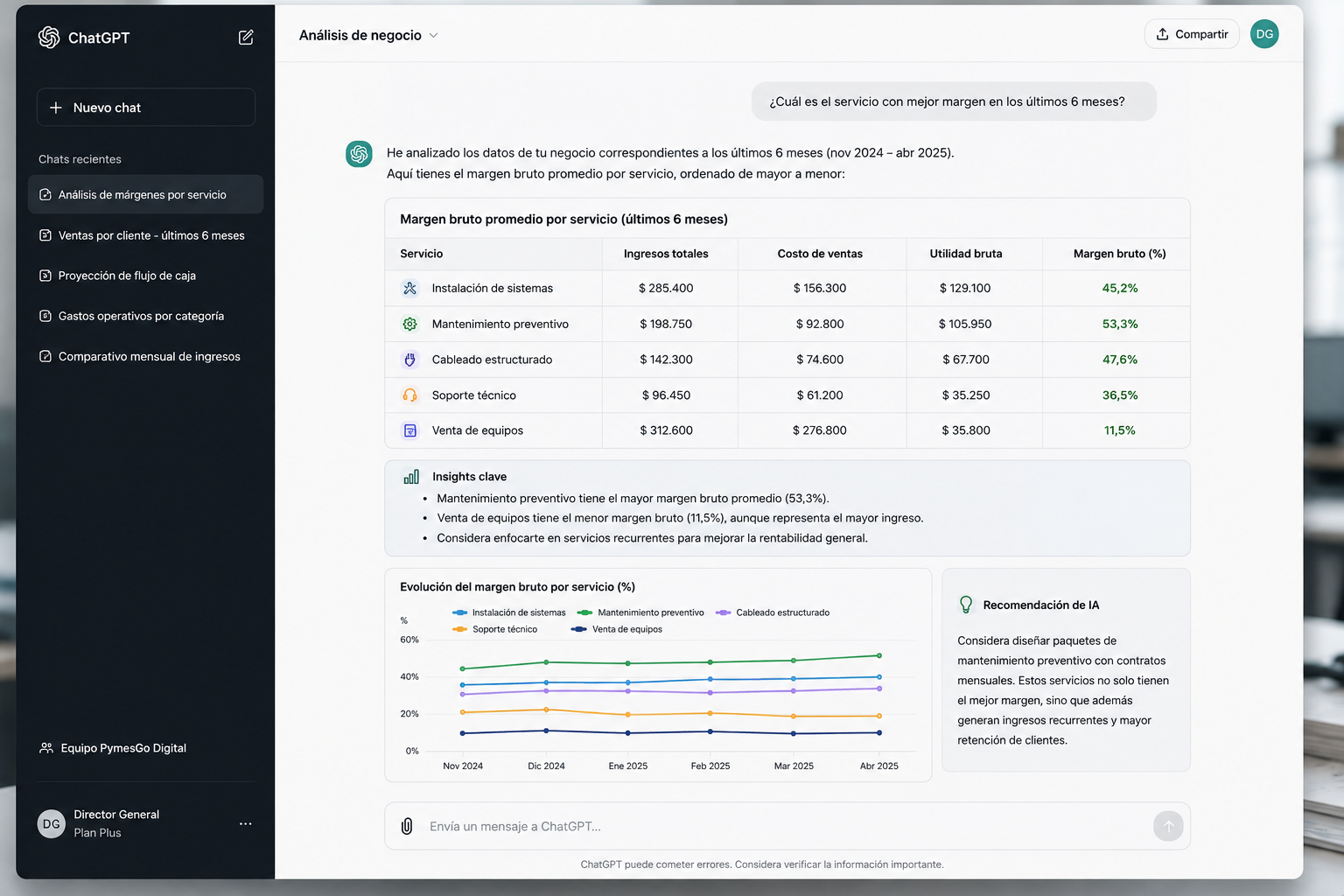
In concrete terms: you upload your quarterly sales report or monthly financial statement to a tool like ChatGPT or Claude, and you ask which service has the best margin, which client represents the highest churn risk, or what the cost trend has been over the last 6 months. The tool reads the file, identifies patterns, and gives you a structured answer.
It's an assistant that processes information faster than any person can do manually. With concrete limitations: it depends on the data it receives, it doesn't update itself in real time, and the final decision is always made by the person who knows the business.
Why Most SME Owners Operate Without Real Analysis
The Data Exists but Isn't Connected
A typical technical company has its sales in a CRM or spreadsheets, its project costs in another system, its technical hours in another, and its financial information in the accounting software. No one connects them automatically. Making that cross-reference takes time that almost no owner has.
Decisions Are Made on the Fly
According to HLB's SME Business Outlook 2026 report, 35% of SME leaders still make strategic decisions based on "various opinions" rather than structured data. The alternative (analyzing the data before deciding) consumes time that most owners don't have.
Strategic Time Always Loses Against Operational Time
SME owners work between 60 and 70 hours per week, and most of that time is absorbed by operations, personnel, and cash flow. Business analysis, which should inform the most important decisions, is systematically displaced.
AI Adoption for Analysis Remains Low
The same HLB 2026 report indicates that barely 1 in 5 SMEs uses AI to support their planning and strategic projections. Most use AI tools for specific tasks (drafting emails, generating content), but still don't apply them to analyzing their own operations.
What Types of Analysis Can AI Do for You
Profitability Analysis by Project or Service
You upload your project history with costs and revenue and ask the AI which type of work has the best margin. For an electronic security company, that might mean discovering that maintenance contracts are 2 times more profitable than new installation projects, even though the latter generate less total revenue. That difference changes how you sell.
Identification of Trends in Sales and Costs
With data from the last 12 or 18 months, AI can identify seasonality, periods of higher demand, customer behavior patterns, and cost variations. What would manually take hours of work in Excel, a well-used tool produces in minutes.
Basic Scenario Evaluation
What happens if I hire 2 more technicians? If I raise prices by 10%? If I lose my largest client? With organized financial information, AI can model basic scenarios and give you a starting point for discussion. These are estimates with a margin of error. Their value lies in forcing the conversation about scenarios before the decision becomes urgent.
Executive Summaries of Extensive Reports
A 40-page report from your accountant or a management report with dozens of metrics can be summarized into 5 points that really matter for making decisions. Instead of reading the entire document, you ask the AI what's most relevant and what requires your attention.
Customer and Retention Analysis
Which customers haven't purchased in more than 6 months? Which have the highest average ticket? Which generate the most post-sale support? With a basic export from your CRM or billing system, AI can answer those questions and help you prioritize where to focus commercial energy.
What Tools Exist Today for This
The 3 most accessible for SME owners who don't have a technology team are:
ChatGPT (OpenAI): the most widely used tool. It accepts Excel, PDF, and CSV files. You can upload your reports directly and ask questions in natural language. The paid version (ChatGPT Plus or Team) offers better analysis capability and a higher data limit.
Claude (Anthropic): Especially strong in analyzing long documents and detailed reasoning. Useful when the report or document you need to analyze has a lot of text or a complex structure.
Microsoft Copilot: If your company already uses Microsoft 365, Copilot is integrated into Excel, Word, and Teams. It can analyze spreadsheets directly, generate meeting summaries, and cross-reference data between documents without leaving the environment you already use.
According to data from the U.S. Chamber of Commerce, 58% of small businesses already apply generative AI as of 2025, compared to 40% the previous year. Companies that adopt it report an average savings of 5.6 hours per week per worker and 7.2 hours per week for managers and directors.
What Your Company Needs Before Starting
Information in some exportable format. AI cannot analyze data that's on paper or in someone's memory. You need it to exist in Excel, PDF, CSV, or in some system from which you can extract a report. If it's not digitized, that's the first step.
Clarity about what question you want to answer. "Analyze my business" is not a useful instruction. "Tell me which service has the best margin over the last 6 months" is. The quality of the analysis depends largely on the quality of the question.
Criteria to validate the results. AI can make mistakes when interpreting data, especially if the file has inconsistencies or if the industry context isn't evident. Whoever reviews the analysis has to understand enough about the business to detect when something doesn't make sense.
Common Mistakes When Starting
Uploading data without context. If you upload an Excel with columns that say "Type A," "Cat. 3," or internal abbreviations, AI can't interpret them well. The files that work best are those that any person with common sense could understand.
Expecting definitive answers. AI produces analysis, not verdicts. Its projections and comparisons are starting points for your judgment, not closed conclusions.
Using it once and abandoning it. The greatest value of analysis with AI lies in consistency. A quarterly analysis compared to the previous one, monthly margin tracking, regular customer review: repetition is what converts the exercise into real business intelligence.
Working with outdated data. A profitability analysis based on prices from 2 years ago yields erroneous conclusions. AI amplifies the quality of the data you give it, for better and for worse.
How to Start: 5 Steps
Step 1. Identify the most urgent question you have about your business right now. Just one. What's the most profitable service? Which customers have the highest risk of leaving? In which month of the year do cash flow problems concentrate? That question defines what data you need.
Step 2. Export the relevant data in the cleanest format you have. An Excel of sales by project, a billing report, a financial statement in PDF. What answers that question is sufficient.
Step 3. Upload the file to ChatGPT, Claude, or Copilot and formulate the question precisely. Include context: what type of company yours is, what the columns mean if they're not obvious, what period the information covers.
Step 4. Read the analysis with judgment. Identify which part makes sense, which part requires verification, and which part generates new questions. The analysis doesn't end when the AI responds: it ends when you decide what to do with that information.
Step 5. Repeat the exercise the following month with the same updated data set. The comparison between periods is where the analysis becomes truly useful.
What Changes When You Analyze Your Business Regularly
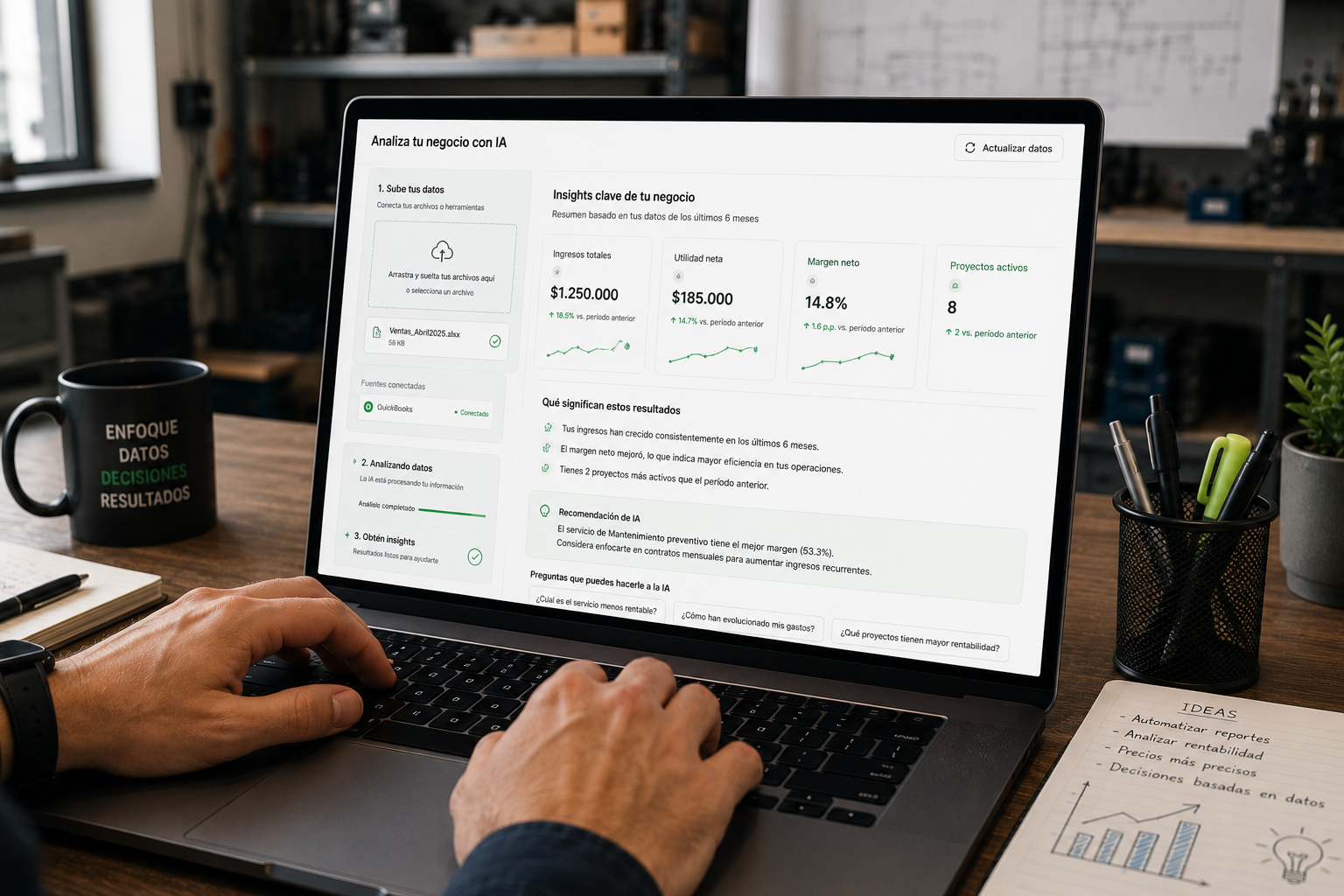
A technical business owner who reviews their margins by service every quarter makes different decisions than one who reviews them once a year. They know sooner if a type of project stops being profitable. They identify sooner if a customer is at risk. They adjust their prices or cost structure sooner.
Almost all technical companies have sufficient data. The problem is the time it takes to process it.
According to McKinsey, 88% of organizations already use AI in at least one business function. The difference between those that generate real value and those that don't is usually whether the tool is used systematically or only when an urgency arises.
It requires the files you already have and the right questions.
Want to Explore More AI Applications for Managing Your Company?
This article is part of the Hub AI for SME Owners (Business Copilot), where you'll find use cases, practical applications, and resources to make better decisions with artificial intelligence.